




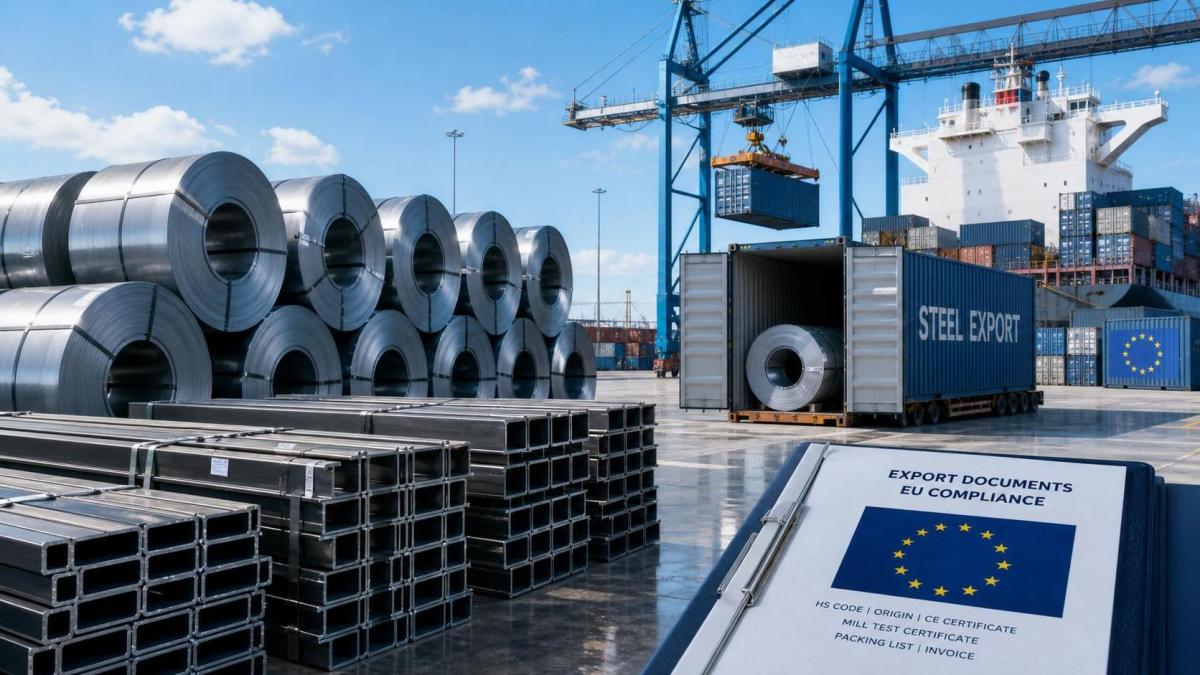
On July 1, 2026, the EU formally began the transition-stage reporting obligation under CBAM for steel products, creating a new compliance requirement for Chinese manufacturers and exporters supplying steel and structural sections to the EU market. The change matters because it shifts carbon data reporting from a peripheral issue to a practical trade condition tied to customs clearance, future market access, buyer due diligence, and supplier qualification review across the export supply chain.
What the new reporting requirement now covers
According to the confirmed information provided, from July 1, 2026, the CBAM transition period is fully in effect for relevant steel exports to the EU. Chinese manufacturers and exporters shipping steel products and sections to the EU are required to submit quarterly reports containing detailed product data, including embedded carbon emissions. The provided information also states that non-compliant reporting may affect customs clearance and later eligibility for entry during the formal phase. In addition, the requirement is directly linked to overseas buyers' procurement compliance responsibilities, supplier qualification reviews, and the need for coordinated carbon data across the supply chain.
Where the pressure is likely to appear first in trade execution
Export transactions now depend more heavily on reporting readiness
From an industry perspective, exporters are likely to feel the impact first because the reporting obligation is attached to products already moving into the EU market. The practical effect is not limited to filing work alone. It may influence shipment preparation, document coordination, internal product data collection, and communication with customers on what information must be available before or during delivery cycles. What deserves closer attention is that reporting failure is described as relevant to customs clearance and later market access, which raises the operational importance of complete and timely submission.
Manufacturing sites face closer scrutiny on product-level carbon data
Analysis shows that manufacturers supplying the EU market may face greater pressure to organize embedded emissions data at the product level. The rule change is relevant because the quarterly report requirement is tied to detailed product information rather than only commercial shipment records. For production-side companies, this may affect internal record preparation, coordination between technical and export teams, and the ability to support downstream customers or traders with consistent data for compliance use.
Overseas buyers and procurement teams may tighten supplier checks
Observably, buyers are also directly implicated because the provided information links the new obligation to procurement compliance responsibility and supplier qualification review. In practice, this means procurement functions may pay closer attention to whether suppliers can provide the required carbon-related product information on time and in a usable format. The impact is likely to be felt in supplier onboarding, qualification retention, contract review, and order allocation decisions where reporting capability becomes part of commercial reliability.
Supply chain service coordination becomes more important
From an industry perspective, service providers involved in export documentation, trade coordination, and supply chain support may also be affected because the rule increases the need for synchronized product data across multiple parties. Even where they are not the core reporting entity, they may need to align shipment records, product descriptions, and supporting documentation more carefully so that trade execution and compliance reporting do not diverge.
What companies should watch in the near term
Readiness of quarterly reporting records
Analysis shows that companies shipping relevant steel products to the EU should pay immediate attention to whether they can assemble complete quarterly product data, including embedded carbon emissions information, in a consistent format. The provided information confirms the reporting obligation, but it does not set out detailed operational templates here, so the key point for now is readiness rather than assuming a finalized internal process is already sufficient.
Supplier qualification and buyer-facing documentation
What deserves closer attention is the link between CBAM reporting and supplier qualification review. Companies may need to examine whether existing customer-facing technical files, trade documents, and supplier approval materials are adequate for buyer compliance checks. This should be understood as a practical documentation issue as much as a regulatory one, especially where exporters rely on multiple upstream producers or processing partners.
Delivery planning and customs-related execution risk
Observably, the reference to customs clearance means companies should treat reporting quality as part of shipment risk management. That does not confirm a uniform outcome for every transaction, but it does indicate that reporting gaps could affect execution timing and downstream delivery commitments. Businesses with recurring EU orders may therefore need closer coordination between sales, logistics, compliance, and production data teams.
Follow-up interpretation and market-side implementation
Analysis shows that companies should continue monitoring how the requirement is interpreted in procurement practice, supplier audits, and transaction documentation. Since the input does not provide detailed enforcement methodology beyond the reporting obligation and its stated consequences, businesses should avoid assuming that current market practice is fully settled. The more practical focus is to track evolving execution language in customer requests, qualification checks, and supporting trade paperwork.
Why this looks more like an execution signal than a distant policy topic
Observably, this development is more appropriate to understand as an active compliance signal rather than a general policy discussion. The reason is that the change is tied to a defined effective date, a recurring reporting duty, and explicit consequences related to customs clearance and later formal-stage access. At the same time, analysis shows that the market still needs to watch how this requirement is translated into day-to-day review standards, document expectations, and supplier screening practices. In that sense, the rule is already operational in principle, while some execution details still merit continued observation.
How the market is likely to read this development now
From an industry perspective, the main significance of this update is that carbon reporting for relevant steel exports to the EU should now be treated as part of trade compliance infrastructure, not as a secondary sustainability topic. The confirmed facts support a cautious but clear reading: this is a landed rule change with direct implications for exporters, manufacturers, buyers, and supply chain coordination, while the precise market response and working-level interpretation still require ongoing attention.
Basis of this article and what still needs verification
This article is based on the user-provided news title, event date, and event summary. For developments of this kind, commonly relevant source types may include official announcements, regulatory authority releases, customs or trade administration information, industry association updates, standards-related documents, and reporting by authoritative media. No specific official source link was provided in the input, so the precise official reference still needs to be verified on an ongoing basis. Follow-up attention should remain on policy detail, implementation language, qualification review practice, procurement document changes, market feedback, and how companies are actually carrying out the reporting requirement.
By clicking 'Allow All', you agree to the storage of cookies on your device to enhance site navigation, analyze site usage and assist with our marketing efforts. Coo Cookie Notice