




From July 9, 2026, the European Commission has moved carbon footprint disclosure for certain imported steel products from a compliance expectation to a customs gatekeeping requirement. For exporters shipping hot-rolled coil, cold-rolled sheet, H-beams, square and rectangular tubes, and other key structural and flat steel products into the EU, the issue is no longer only environmental reporting. It now directly affects document readiness, shipment timing, customs clearance, and market access, making it a matter that steel exporters, processors, traders, and supply chain service providers need to track closely.
What Has Taken Effect on July 9
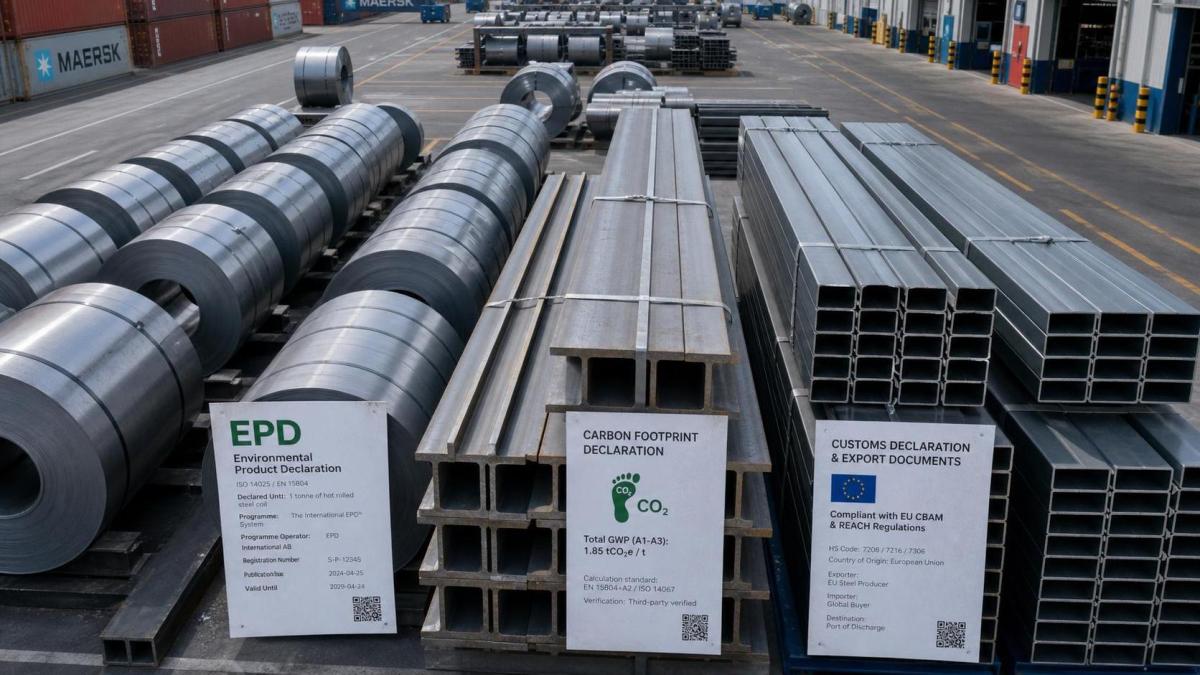
According to the provided information, from 00:00 on July 9, 2026, the European Commission began mandatory enforcement of the carbon footprint declaration system under Annex L of EN 15804+A2:2026 for major imported steel categories, including hot-rolled coil, cold-rolled sheet, H-beams, and square and rectangular tubes.
The requirement applies to imports entering the EU. Exporting companies must obtain verification from an EU-recognized third-party body and upload an EPD (Environmental Product Declaration) to the CPM platform. If this process is not completed, customs clearance will be refused.
The same information also states that the rule directly affects the delivery cycle, certification costs, and market access eligibility of Chinese steel exporters.
Where the Immediate Pressure Will Be Felt
Exporters face a new customs threshold
From an industry perspective, direct trading companies exporting covered steel products to the EU are likely to be the first group affected. The reason is straightforward: the rule is tied to verification, platform submission, and customs acceptance. The main pressure points are likely to appear in pre-shipment compliance checks, document preparation, and shipment scheduling. What deserves closer attention is whether existing export workflows already account for third-party verification and EPD upload timing.
Processors and manufacturers may see compliance move upstream
For processing and manufacturing companies supplying EU-bound steel products, the impact may not stop at the trading entity. Analysis shows that once customs clearance depends on a verified carbon footprint declaration, product-level supporting information and internal coordination may become more sensitive parts of order execution. The practical concern is not only whether a product can be sold, but whether it can move through the compliance chain in time to meet agreed delivery dates.
Supply chain and service providers enter the compliance path
Observably, third-party verification, EPD handling, and platform submission make service providers more relevant to transaction execution. For logistics coordinators, customs service teams, documentation providers, and related intermediaries, the issue is likely to center on whether compliance steps are completed before cargo reaches the customs stage. In this sense, operational delays may arise from documentation gaps as much as from physical shipping issues.
Buyers and distributors may focus more on fulfillment certainty
For EU-facing buyers, distributors, and downstream procurement teams, the new requirement may increase attention on supplier readiness rather than price and volume alone. The likely impact is on supplier screening, order confirmation, and delivery risk assessment. What deserves closer attention is whether suppliers can demonstrate that verification and EPD submission are already built into routine export execution.
What Companies Should Watch Now
Check whether target products fall within the covered categories
The provided information identifies hot-rolled coil, cold-rolled sheet, H-beams, and square and rectangular tubes, along with other major structural and flat steel products. Companies should first focus on whether their EU-bound product mix falls within these categories, because the business impact begins with product scope.
Separate certification completion from shipment preparation
Analysis shows that this requirement is not simply a paper formality attached to customs filing at the end of the process. Because verification by an EU-recognized third party and EPD upload to the CPM platform are required before customs acceptance, companies should treat compliance completion and shipment preparation as linked but distinct workflows. The practical issue is whether internal planning leaves enough time for both.
Pay attention to delivery commitments and customer communication
The provided information specifically notes possible effects on delivery cycles and certification costs. For companies already serving EU customers, this makes delivery promises, contract timing, and customer communication more sensitive. What deserves closer attention is how to explain documentation lead times, possible review timing, and order readiness without waiting until cargo is close to shipment.
Track rule wording and operational interpretation separately
Observably, there is often a difference between a formal requirement and the way it is applied in day-to-day execution. Based on the provided information, the mandatory elements are clear: verification, EPD upload, and the consequence of customs refusal if these steps are missing. Companies should continue watching for any further official wording, procedural clarification, or operational guidance that could affect execution details.
How This News Is Better Understood
Analysis shows that this is more than a short-term procedural update. Because the requirement is directly tied to customs clearance, it already has immediate operational consequences for covered steel exports into the EU. At the same time, it is also more appropriate to understand this as a longer-term market access signal: carbon footprint documentation is no longer peripheral to trade execution for the affected products.
That said, this news should not be overstated beyond the provided facts. The confirmed information establishes a binding requirement and a clear customs consequence, but further market responses, cost transmission patterns, and category-specific execution differences still need observation rather than assumption.
Why the Market Will Keep Watching
In practical terms, the significance of this development lies in where compliance now sits in the transaction process. It is no longer only a reporting matter; for the covered steel products, it has become part of the path to customs release. A neutral reading is that the rule should currently be understood as both an immediate operating requirement and a broader signal about how EU market entry standards are being applied to steel trade. The next phase of attention should remain on execution, not speculation.
Basis of This Article
This article is based on the user-provided news title, event date, and event summary. For this type of industry update, relevant source categories typically include official notices, company announcements, industry association information, authoritative media reporting, and standards organization documents. No specific official source link was provided in the input, so the exact official reference still requires ongoing verification. Continued attention should be given to any subsequent official clarification on scope, verification procedures, platform submission requirements, and customs implementation practice.
By clicking 'Allow All', you agree to the storage of cookies on your device to enhance site navigation, analyze site usage and assist with our marketing efforts. Coo Cookie Notice