




On August 1, 2026, the U.S. Department of Commerce announced an administrative review of antidumping measures on hot-rolled coil (HRC) from China, covering export shipments made from July 1, 2025 to June 30, 2026. For steel exporters, U.S. buyers, traders, and supply chain service providers, the development matters because it is not only a procedural update but also a direct compliance and pricing issue: the review will revisit duty rates, examine separate-rate eligibility, and require complete transaction, cost, and related-party documentation, with a filing deadline that can materially affect quotations, customs timing, and purchasing decisions.
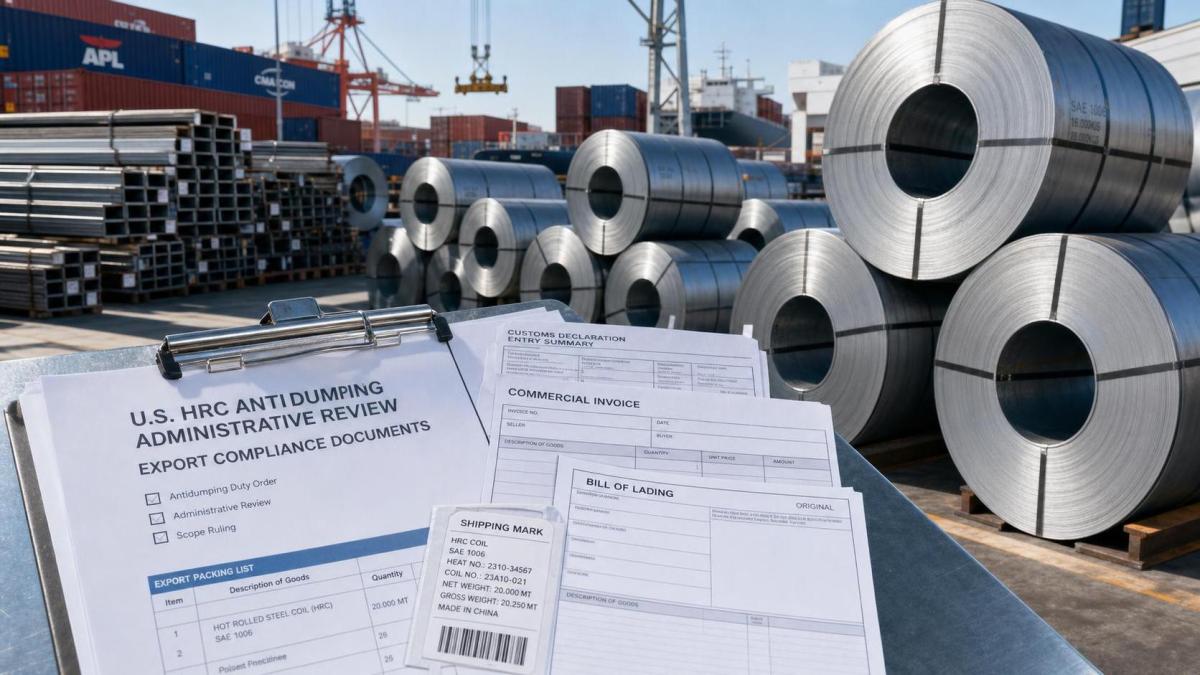
What the Review Covers This Time
The confirmed facts are limited but clear. The U.S. Department of Commerce stated on August 1, 2026 that it has initiated an antidumping administrative review concerning HRC originating in China. The review period covers export batches shipped between July 1, 2025 and June 30, 2026.
According to the event summary provided, this review will recalculate duty rates, reassess whether exporters and producers qualify for separate rates, and require submission of complete records relating to export transactions, production costs, and related-party support materials.
The same summary states that steel exporters shipping to the United States must submit response materials by September 15. If filings are not completed on time, a high default duty rate will apply. The stated direct areas of impact are export quotations, customs clearance timing, and buyer procurement decisions.
Where the Operational Pressure Is Likely to Appear
Exporters facing immediate documentation risk
From an industry perspective, exporters are the first group affected because the review directly ties duty outcomes to filing quality and timing. The pressure point is no longer limited to pricing strategy; it extends to whether transaction records, cost data, and related-party materials can be assembled in a form that supports the company's position within the review.
What deserves closer attention is the connection between compliance files and commercial execution. If a company cannot complete its response by the stated deadline, the risk is not abstract. The event summary explicitly indicates exposure to a high default duty rate, which can feed back into offer validity, margin assumptions, and negotiation with U.S. customers.
Buyers and traders reassessing procurement visibility
U.S.-linked buyers and trading intermediaries may also feel the effect because the review introduces uncertainty into near-term landed cost calculations and supplier selection. Analysis shows that when duty rates are under review and separate-rate status is being checked, procurement teams may pay closer attention to the exporter's ability to maintain compliant records and complete filings on time.
For this group, the practical concern is not only the customs side but also quotation reliability. If the exporter's review exposure is unclear, the buyer may need to revisit purchasing schedules, compare sourcing options more carefully, or seek stronger documentary assurance before confirming orders.
Logistics and customs service providers watching clearance timing
Supply chain service providers, including customs and shipment coordination functions, are also likely to monitor this development closely. The event summary already points to possible effects on customs clearance timing, which means service providers may need to pay closer attention to document consistency, shipment traceability, and timing alignment between commercial paperwork and review-related filings.
Observably, this is the type of rule-driven development that can move beyond legal review and into day-to-day shipment management when filing deadlines and documentation standards begin to affect release schedules and transaction handling.
What Companies Should Be Checking Now
Whether transaction records are complete enough for review use
Analysis shows that companies involved in covered exports should focus first on the completeness of export transaction records within the review period. Because the provided summary specifically mentions full export transaction documentation, businesses should pay attention to whether contract, invoice, shipment, and counterpart-related records can be matched and presented consistently.
Whether cost and related-party materials can withstand scrutiny
The review is also described as requiring cost information and related-party supporting documents. It is therefore more appropriate to understand this stage as a documentation readiness test as much as a tariff review. Companies should closely examine whether internal cost records and related-party explanations are organized, traceable, and aligned with the export transactions covered by the review period.
Whether separate-rate status is exposed to filing gaps
The event summary makes clear that separate-rate eligibility will be examined. For affected exporters and producers, this means the review may influence more than the final rate calculation alone. What deserves closer attention is whether any inconsistency, omission, or late submission could weaken the company's ability to defend its rate position during the review process.
Whether quotations and delivery commitments need adjustment
Because the summary directly links the review to export quotations, customs timing, and buyer decisions, companies should also assess how open U.S.-bound offers are being structured during the response window. This is not yet a confirmed market outcome, but an operational point to monitor: where filing uncertainty exists, pricing assumptions, delivery commitments, and procurement communication may all require tighter internal review.
Why This Reads as an Execution Signal
Analysis shows that this development is better understood as an active enforcement and execution signal rather than a distant policy headline. The reason is straightforward: the review has a defined coverage period, a stated filing deadline, and explicit consequences tied to incomplete or delayed responses.
At the same time, it would be premature to treat the matter as a settled commercial result. The provided information confirms the opening of the review and the compliance demands around it, but it does not provide a final duty outcome or a completed enforcement conclusion. Observably, the current stage calls for close monitoring of how companies respond and how review requirements are carried into practical trade execution.
How the Market Should Read the Next Step
The immediate significance of this event lies in the fact that trade compliance, pricing, and shipment execution are now more tightly connected for covered HRC exports to the United States. For the industry, the key message is not simply that a review has started, but that documentary readiness and filing discipline may shape commercial discussions in the short term.
It is more appropriate to understand this development as a live rule-driven process with direct operational consequences, rather than as a completed outcome. The market still needs to watch how the review proceeds, how participants respond within the filing window, and whether later implementation signals affect procurement and delivery decisions.
Basis of This Article and What Still Needs Verification
This article is generated based on the user-provided news title, event date, and event summary. For developments of this kind, commonly relevant source categories may include official announcements, releases from regulatory authorities, customs or trade administration updates, industry association notices, standard-setting documents, and reporting from authoritative media.
No specific official source link was provided in the input, so the official publication path and any later procedural details still require ongoing verification. Observably, the areas that merit continued attention include any further official wording, practical compliance interpretation, changes in tender or procurement documents, industry feedback, and how affected companies carry out their filings and trade execution during the review period.
By clicking 'Allow All', you agree to the storage of cookies on your device to enhance site navigation, analyze site usage and assist with our marketing efforts. Coo Cookie Notice