



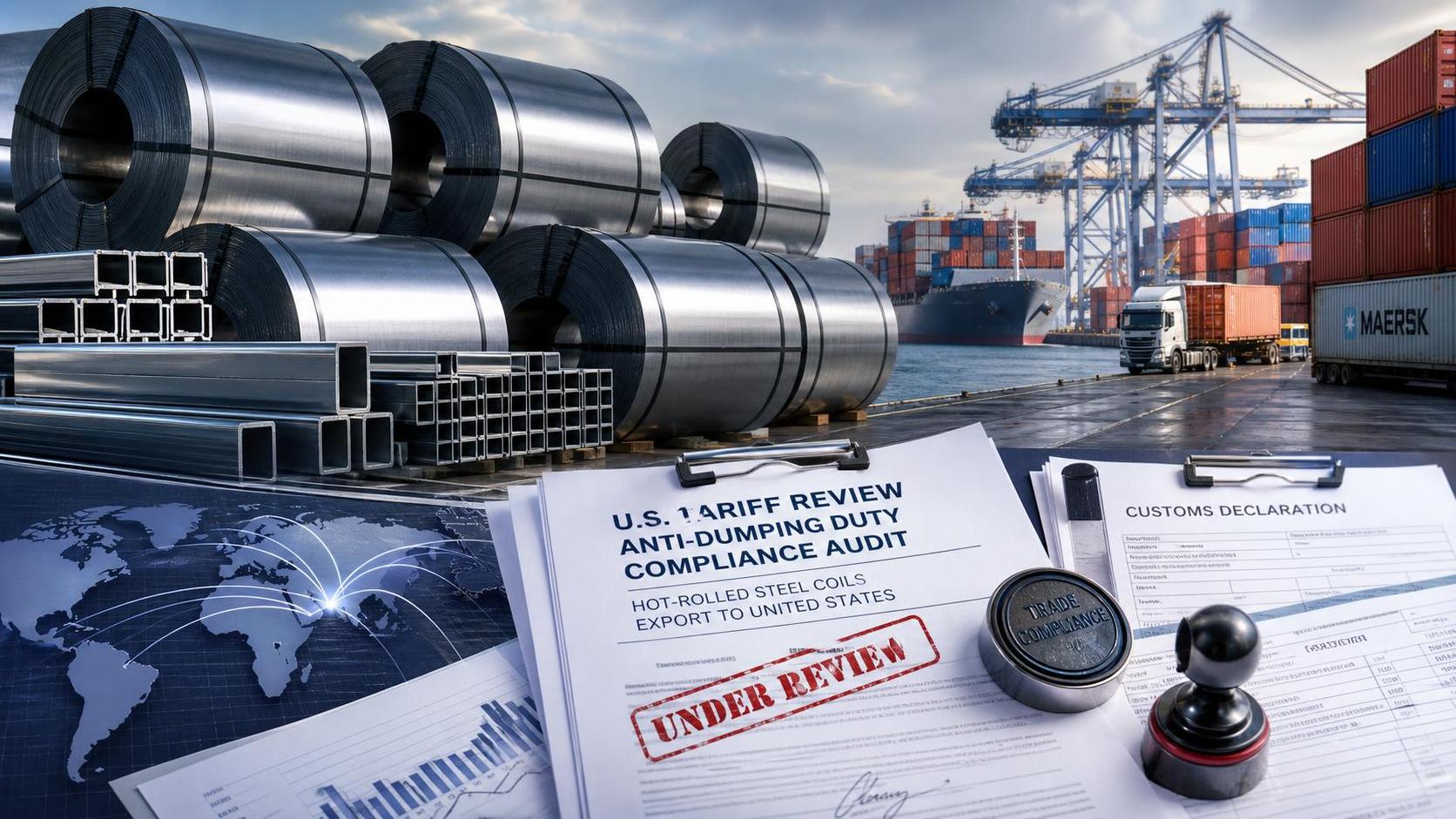
On July 22, 2026, the U.S. Department of Commerce announced an expedited sunset review of the anti-dumping duty order covering hot-rolled coil from China. The review concerns the 2021-2025 duty period and matters to exporters, U.S.-bound suppliers, procurement teams, and trade compliance functions because its outcome can shape the compliance route and customs cost structure for shipments entering the U.S. from 2027 onward.
What Has Officially Been Announced
The confirmed fact is that the U.S. Department of Commerce has initiated the first expedited sunset review of the anti-dumping duty order on hot-rolled coil originating in China. The announcement was made on July 22, 2026. The review covers the effective duty period from 2021 to 2025 and will examine whether continuing the anti-dumping duties remains consistent with the interests of the domestic industry in the United States. The stated practical consequence is that the result will directly affect the compliance pathway and customs clearance cost of hot-rolled coil exports to the U.S. starting in 2027.
Where the Immediate Pressure Points May Appear
Export planning is likely to become more cautious
From an industry perspective, exporters of hot-rolled coil to the U.S. may be affected first because the review relates directly to future market access conditions. The impact is not yet a confirmed rule change for 2027, but it creates a live compliance variable for contract planning, pricing discussions, and shipment scheduling tied to the U.S. market. What deserves closer attention is whether internal trade files, product descriptions, and customs-related documentation are prepared in a way that can support later compliance decisions.
Procurement and sourcing teams may need to reassess timing and cost assumptions
For buyers and sourcing functions that depend on hot-rolled coil linked to U.S. delivery, the issue is not only tariff exposure but also planning reliability. Analysis shows that this kind of review can matter to procurement cycles because future landed cost assumptions, supplier comparisons, and order timing may need closer review. Teams involved in U.S.-related purchasing should pay attention to how duty-related uncertainty could affect supplier selection, quote validity, and delivery cost allocation.
Processing and manufacturing operations should watch downstream contract terms
Manufacturers and processors using hot-rolled coil in products destined for the U.S. may also feel the effect through order commitments and delivery terms rather than through the review procedure itself. Observably, if a trade measure remains under review, downstream businesses often need to look more carefully at specification matching, documentary traceability, and customer contract language linked to origin, delivery timing, and customs responsibility. The current notice does not establish a new execution rule for these firms, but it does raise the importance of document discipline.
Logistics and customs support functions face a higher documentation burden
Supply chain service providers, customs support teams, and trade operations staff may need to prepare for greater scrutiny around shipment classification, origin-related files, and clearance planning for future U.S.-bound transactions. It is more appropriate to understand this as an early compliance signal rather than as a final operating rule, but businesses in these roles should still monitor whether later official language affects documentation standards or clearance expectations.
Practical Issues Companies Should Track Now
Review internal compliance files for U.S.-bound business
Analysis shows that companies involved in exporting or supplying hot-rolled coil to the U.S. should revisit internal records tied to origin, product scope, and transaction documentation. The current announcement does not provide a final execution outcome, so the immediate task is not to assume a settled result but to make sure compliance materials can support future review or customs needs.
Follow official wording and any later execution guidance
What deserves closer attention is how later official statements describe the review outcome and its operational implications for 2027 shipments. Businesses should avoid treating the current announcement as a completed policy decision. Instead, they should track whether subsequent notices refine the compliance path, the applicable trade interpretation, or the customs treatment relevant to future exports.
Recheck contracts, quotations, and delivery commitments
For sales, procurement, and trade management teams, a practical response is to examine whether existing quotations, contract terms, and delivery commitments sufficiently address duty-related uncertainty tied to the U.S. market. This is especially relevant where pricing, responsibility for customs costs, or delivery timing may be sensitive to later rule execution.
Prepare for closer scrutiny in supply chain coordination
Observably, periods of trade review often increase the need for tighter coordination between suppliers, exporters, logistics providers, and customers. Companies should therefore pay attention to document consistency, traceability support, and the readiness of technical and commercial files that may be referenced during cross-border delivery or customs processes.
Why This Looks More Like a Regulatory Signal Than a Final Outcome
Analysis shows that this development is better understood as an active regulatory and trade-policy signal rather than as a completed rule change. The review has been launched, and that fact alone matters because it introduces a defined process affecting future compliance and cost expectations for 2027. At the same time, the input provided does not include a final determination or detailed implementation language. For that reason, the market should treat this as a live policy development that requires continued observation rather than a settled endpoint.
How the Market Should Read This Stage
The significance of this announcement lies in its effect on planning discipline. It points to a review process that can influence future export compliance routes and customs costs for Chinese hot-rolled coil entering the U.S. The most balanced reading at this stage is that the measure has moved into a meaningful execution process, but the practical impact for companies still depends on later official outcomes and how those outcomes are applied in trade operations.
Basis of This Article and What Still Needs Verification
This article is generated from the user-provided news title, event date, and event summary. For developments of this type, relevant source categories usually include official notices, releases from regulatory authorities, customs or trade administration information, industry association updates, standard-setting documents, and reporting by authoritative media. A specific official source link was not provided in the input, so the exact source text still needs to be verified on an ongoing basis. Further observation should focus on later policy wording, implementation interpretation, procurement document changes, bidding document adjustments, market feedback, and how companies apply the requirements in practice.
By clicking 'Allow All', you agree to the storage of cookies on your device to enhance site navigation, analyze site usage and assist with our marketing efforts. Coo Cookie Notice