




On August 3, 2026, the U.S. Department of Commerce announced the start of an annual anti-dumping and countervailing duty review covering hot-rolled coil from China shipped during the period from April 1, 2025 to March 31, 2026. For exporters, importers, and North American buyers, the development matters because it can affect duty rate determination, customs documentation, supplier compliance checks, and the way procurement costs are estimated in current and upcoming transactions.
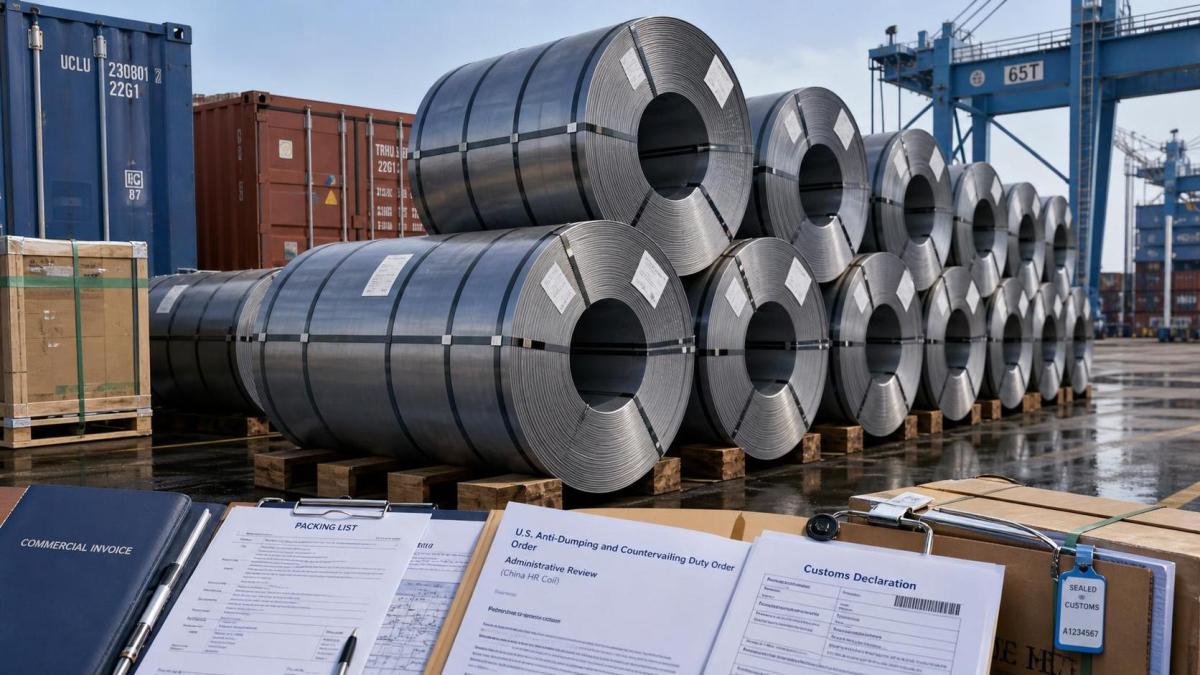
What the review formally covers
The confirmed facts available show that the U.S. Department of Commerce has opened annual AD and CVD review proceedings for Chinese hot-rolled coil. The review applies to export shipments made between April 1, 2025 and March 31, 2026. The announced scope of attention, based on the provided event summary, includes the tax rate assessment facing exporting companies, the preparation of customs clearance documents, the cost forecasting work of North American buyers, and the need for importers to reassess supplier compliance qualifications and quotation structures.
Where the pressure points may appear in the supply chain
Export transactions may face renewed scrutiny on rate exposure
From an industry perspective, Chinese exporters are likely to focus first on how the review may influence final duty rate determination tied to covered shipments. The practical impact is not only financial. It also reaches quotation discipline, supporting trade records, and the consistency of shipment-level documentation tied to exports within the review period.
Import-side operations may need tighter compliance screening
For importers, the immediate relevance lies in supplier qualification review and customs-related document readiness. Analysis shows that importer risk is connected to whether supplier information, transaction records, and filing materials remain aligned with review requirements. What deserves closer attention is that procurement decisions may no longer be judged only by nominal offer price, but also by the supplier's ability to support compliance review.
North American buyers may need to revisit cost assumptions
For buyers in North America, the event may affect purchasing budgets and landed cost estimates. Observably, this does not automatically mean a fixed cost outcome, but it does mean that buyers relying on Chinese HR coil supply should reassess how duty-related uncertainty is reflected in contract pricing, sourcing comparisons, and delivery planning.
Service providers in the trade chain may see more documentation work
Supply chain service providers, including those involved in customs documentation and shipment coordination, may also be affected indirectly. The reason is straightforward: when a review is underway, the accuracy, completeness, and timing of document preparation can become more consequential for clearance and internal compliance review processes.
What companies should watch now
Track official wording and procedural updates closely
Companies involved in covered shipments should follow subsequent official expressions and procedural developments linked to the review. Analysis shows that the announcement of initiation is a confirmed step, but the operational significance for each company depends on how later requirements are presented and applied.
Check shipment records within the stated review period
A practical priority is to identify whether relevant export batches fall within the April 1, 2025 to March 31, 2026 review window. This matters because the review is tied to a defined shipment period, and internal records, invoice trails, and clearance materials connected to that period may become central to later verification and communication.
Reassess quotation logic, not just headline price
Importers and buyers should revisit quotation structures rather than treating price as a standalone figure. Based on the provided facts, this review may affect cost forecasting, which means procurement teams may need to separate base product pricing from duty-related uncertainty and communicate that distinction more clearly in negotiations and approvals.
Prepare for supplier and customer communication gaps
What deserves closer attention is the difference between a policy process and its business execution. Even where the confirmed facts remain limited to the launch of the review, companies may still need better coordination across sales, compliance, logistics, and customer-facing teams so that questions about supplier qualifications, documents, and delivery timing do not slow transactions.
Why this is better read as a live trade signal
Analysis shows that this development is more appropriately understood as an active procedural signal rather than a final market conclusion. The confirmed event is the launch of the annual AD and CVD review itself. It does not, on its own, settle the eventual commercial outcome for every participant. Even so, the review clearly signals that companies handling Chinese HR coil in the U.S.-linked trade flow should continue monitoring documentation, compliance readiness, and cost assumptions instead of treating existing arrangements as static.
How the market should interpret the announcement
At this stage, the announcement is best understood as a near-term operational issue with broader watch value. In the short term, it has direct relevance for exporters, importers, and buyers managing covered shipments and pricing exposure. In a broader sense, it also serves as a reminder that trade remedy procedures can materially affect transaction execution even before any market participant sees a fully resolved outcome. A neutral reading is that the event requires attention now, while its full business implications still need continued observation.
Basis of this article and what still needs verification
This article is based on the user-provided news title, event date, and event summary concerning the U.S. Department of Commerce's initiation of an annual AD and CVD review of Chinese hot-rolled coil on August 3, 2026. For this type of development, relevant source categories typically include official government notices, company disclosures, industry association updates, authoritative media reporting, and trade or standards-related documents. A specific official source link was not provided in the input, so the underlying notice and any later procedural details still need ongoing verification. Continued attention should be given to subsequent official statements, review-related documentation requirements, and any changes affecting supplier compliance review or procurement cost assessment.
By clicking 'Allow All', you agree to the storage of cookies on your device to enhance site navigation, analyze site usage and assist with our marketing efforts. Coo Cookie Notice