




On July 20, 2026, the U.S. Department of Commerce announced the second annual review of the anti-dumping duty order on hot-rolled steel coils from China, covering export shipments made between April 1, 2025 and March 31, 2026. For exporters, importers, and supply-chain participants handling the affected HS categories, this is not just a procedural update: it directly relates to duty-rate application over the coming 12 months, customs compliance, and landed-cost calculations, which is why document readiness and traceability now deserve closer attention.
What the announced review formally covers
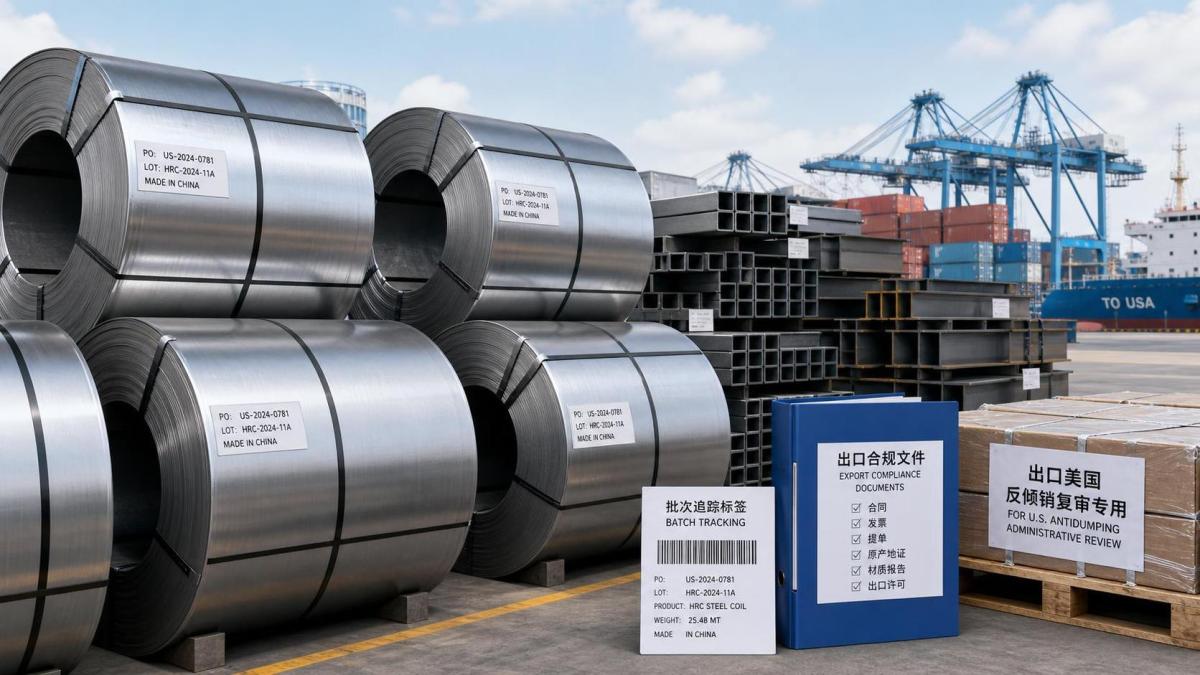
The confirmed facts are limited but commercially significant. The review was formally announced on July 20, 2026 by the U.S. Department of Commerce. It concerns Chinese hot-rolled steel coils, including HS 7210.70 and 7211.14, under a second annual anti-dumping duty review. The review period covers export batches shipped from April 1, 2025 to March 31, 2026. The event summary also states that the outcome of this review will directly affect the duty-rate treatment applied to exports to the U.S. over the next 12 months, as well as customs clearance compliance and importer cost accounting. The same summary identifies origin certificates, cost-structure documentation, and supply-chain traceability materials as key items that companies should prepare in advance.
Where the pressure is likely to show up first
Export transactions face closer documentary scrutiny
From an industry perspective, Chinese exporters of the covered products are the first group likely to feel the practical impact. The reason is straightforward: a review of an anti-dumping duty order can affect how duty rates are applied in future transactions. In operational terms, the pressure points are likely to include shipment files, product classification consistency, origin documentation, cost-supporting materials, and record retention across the review period.
What deserves closer attention is that export compliance in this context is not limited to customs filing alone. Companies involved in sales, logistics coordination, and documentation handover may need to ensure that origin certificates, cost-structure files, and traceability records are internally consistent and can be retrieved without delay.
U.S.-bound buyers and import-side teams must revisit cost assumptions
Importers and purchasing parties connected to U.S.-bound orders may also be affected because the review is explicitly linked to future duty-rate application and importer cost accounting. In practice, this means procurement teams, finance teams, and trade compliance functions may need to reassess how they budget for duty exposure, evaluate supplier files, and manage customs-related documentation for affected shipments.
Analysis shows that the main issue is not only price negotiation. It also concerns whether import-side teams have enough supporting material to align customs declarations, internal landed-cost models, and supplier-provided origin or traceability records.
Supply-chain service providers may see higher coordination demands
For logistics coordinators, customs support providers, and other supply-chain service participants, the impact is likely to appear in execution detail. Where a review increases attention on shipment period, origin, cost basis, and product traceability, service providers may face tighter requests for document matching, batch-level tracking, and communication between exporters and importers.
Observably, this does not automatically change every delivery arrangement, but it does raise the importance of document continuity across booking, customs, and post-shipment recordkeeping.
What companies should monitor now
Keep origin and classification files audit-ready
Analysis shows that companies handling the affected products should first focus on the completeness and consistency of origin-related materials. Because the event summary specifically highlights origin certificates, businesses should review whether shipment files clearly support declared product identity, HS usage, and origin claims for the covered period.
Check whether cost records can support future review requests
The event summary also points directly to cost-structure documentation. That makes internal cost records a practical priority for affected exporters and related trade teams. It is more appropriate to understand this as a documentation-readiness issue at this stage, rather than as a confirmed change in final duty outcome. Businesses should therefore pay attention to whether cost files are organized in a way that can support review-related questions if required.
Strengthen batch-level traceability across suppliers and shipments
Supply-chain traceability materials are explicitly mentioned in the provided facts, which makes traceability a current compliance concern rather than a secondary administrative issue. Companies should watch whether purchase records, production references, shipment batches, and customer-facing export files can be connected in a clear chain. This matters especially where multiple internal departments or external suppliers contribute to one export transaction.
Watch for execution language rather than assuming a final result
No detailed enforcement outcome, revised rate, or final determination has been provided in the input. For that reason, companies should avoid treating the announcement as a completed result. What deserves closer attention is subsequent official wording, implementation practice, and any market-facing adjustments in customs handling, procurement terms, or shipment planning that may follow.
How this signal should be read at this stage
Observably, the current development is best read as an active enforcement and compliance signal rather than a fully settled commercial outcome. The review has already been initiated, so the procedural change is real. At the same time, the input does not provide a final rate decision or a detailed execution framework. From an industry perspective, that makes this a rule-driven development that has entered an operative stage, but one whose concrete downstream effect still requires close observation.
Analysis shows that the practical value of the announcement lies in timing. It gives affected companies a clear reason to prepare files now, especially where duty treatment, customs clearance, and cost allocation for U.S.-bound business depend on documentary support.
A compliance development with near-term commercial consequences
Taken together, this announcement matters because it connects a formal trade-remedy review with near-term decisions on export compliance, import cost calculation, and shipment documentation. It should not be overstated as a final market outcome, but it should also not be treated as a routine notice with no operational effect. It is more appropriate to understand this development as a live execution signal: the review has been launched, the affected shipment period is defined, and the businesses involved should now focus on documentation quality, traceability, and ongoing rule interpretation.
Basis of this article and what still needs verification
This article is based on the user-provided news title, event date, and event summary. For developments of this type, relevant source categories typically include official government notices, regulator releases, customs or trade authority information, industry association updates, standard-setting documents, and reporting from established professional media. A specific official source link was not provided in the input, so that link still needs to be verified on an ongoing basis.
Further observation is still necessary regarding any detailed implementation language, the practical compliance approach used in customs clearance, possible adjustments in procurement or bid documents, market feedback from affected businesses, and how companies execute origin, cost, and traceability preparation in response to the review.
By clicking 'Allow All', you agree to the storage of cookies on your device to enhance site navigation, analyze site usage and assist with our marketing efforts. Coo Cookie Notice