




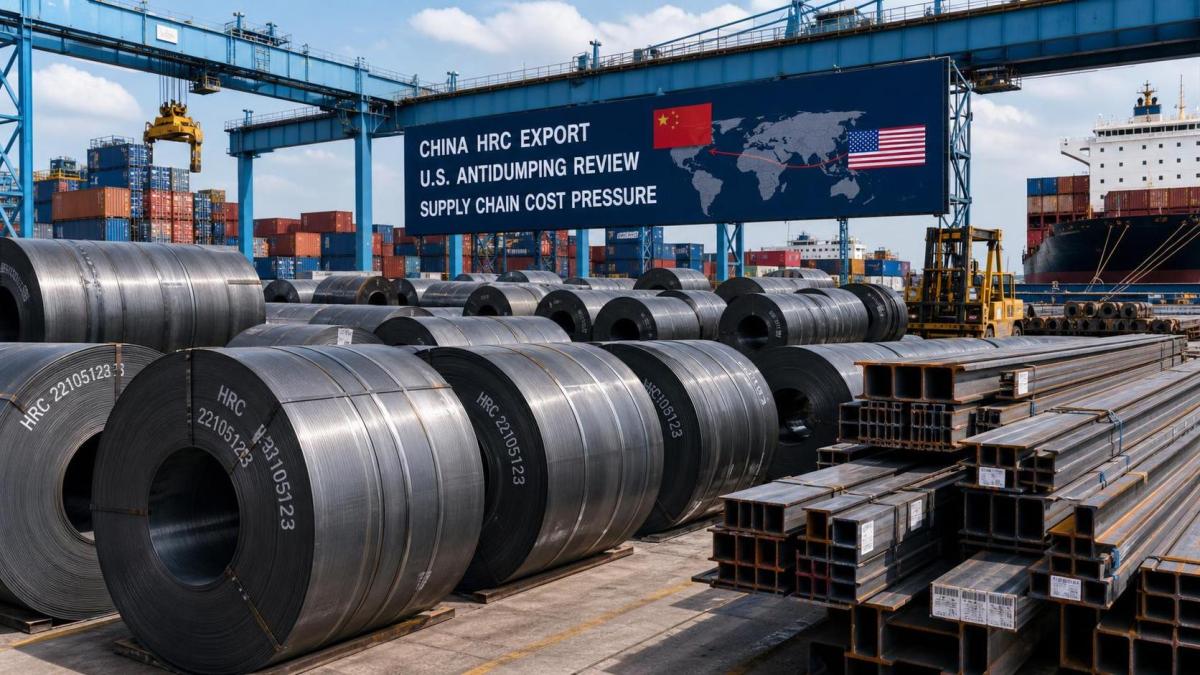
On July 18, 2026, the U.S. Department of Commerce announced the start of the first expedited sunset review of the anti-dumping duty order on hot-rolled coil (HRC) from China. For steel traders, U.S. importers, customs and logistics service providers, and Chinese suppliers, this matters because the review will determine whether the current anti-dumping duties remain in place, shaping purchasing decisions, landed costs, and compliant pricing strategies over the next 12 to 18 months.
What the review formally covers
The confirmed facts are limited but commercially significant. The review concerns HRC originating in China and examines whether the existing U.S. anti-dumping duty order should continue. The current duty range referenced in the announcement is 12.5% to 213.9%. According to the information provided, the review was formally initiated on July 18, 2026, and a result is expected in January 2027.
The proceeding is identified as the first expedited sunset review. Based on the information provided, the core issue is not a new tariff measure, but whether the existing anti-dumping duty order remains in effect after review.
Where the immediate pressure points may appear
Import purchasing decisions face a longer planning window
From an industry perspective, U.S. importers may be affected first because the expected decision timeline reaches into January 2027 while commercial planning often starts earlier. The likely impact is concentrated in sourcing schedules, supplier selection, and cost planning. What deserves closer attention is how companies treat shipments, quotations, and contract timing during the 12 to 18 month window identified in the source information.
Chinese suppliers will need tighter pricing discipline
Analysis shows that Chinese HRC suppliers may feel the impact through quotation strategy and compliance positioning. Because the review will decide whether current anti-dumping duties continue, pricing discussions with U.S.-facing customers may need to account for duty exposure and documentation consistency. The main point to watch is not only price level, but whether offers remain commercially workable under the existing duty range cited in the case.
Customs, clearance, and trade service functions may see higher scrutiny
For customs brokers, trade service providers, and supply chain teams, the pressure may appear in clearance cost estimates, document handling, and customer communication. Observably, when a trade remedy review is active, operational teams tend to focus more closely on how duty-related assumptions are reflected in landed cost planning and transaction paperwork. Based on the provided information, this is especially relevant because the outcome could directly affect customs-related cost expectations.
Downstream buyers may reassess procurement timing
Processors, manufacturers, distributors, and other downstream buyers that rely on imported steel may also need to monitor the review, even if they are not the direct importer of record. The likely impact sits in budget assumptions, procurement timing, and supplier negotiations. What deserves closer attention is whether current offers already reflect the possibility that the existing order will continue.
What companies should monitor now
Separate confirmed procedure from commercial assumptions
The confirmed fact is that the expedited sunset review has started. It is important for companies not to treat the initiation itself as a final outcome. The practical issue is to distinguish between the review process and any internal assumption that duties will either remain unchanged or disappear. That distinction matters for pricing, contracting, and internal approval decisions.
Track future official wording closely
Companies involved in U.S.-China steel trade should monitor subsequent official statements tied to this review. Analysis shows that small changes in official language can matter for how businesses interpret timing, scope, and expected compliance obligations. At this stage, the most relevant action is disciplined monitoring rather than premature commercial conclusions.
Review quotation, documentation, and customer communication flows
Chinese suppliers and trade intermediaries should pay close attention to how quotations are framed, how supporting trade documents are prepared, and how expectations are communicated to customers. Based on the information provided, compliant pricing strategy is one of the areas directly affected, so businesses should make sure their commercial documents and internal assumptions remain aligned.
Prepare procurement and delivery scenarios for the next 12 to 18 months
For importers and downstream users, the source information already points to a 12 to 18 month decision-making horizon. Observably, this makes scenario planning more important than a single-view forecast. Companies may need to compare procurement timing, delivery commitments, and cost exposure under different assumptions while waiting for the January 2027 result.
Why this is a signal, not a conclusion
Analysis shows that this development is better understood as an active policy and trade-compliance signal rather than a completed market outcome. The review has been initiated, but the result has not yet been announced. That means the industry is looking at a process with clear commercial implications, not a settled change in trade conditions. It is more appropriate to understand this as a development that requires continued observation, especially for participants whose pricing, customs cost, or sourcing plans are tied to Chinese HRC.
How to read the development at this stage
The industry significance of this announcement lies in timing and decision risk. The review reopens a key question around whether existing anti-dumping duties on Chinese HRC will remain in force, and that alone is enough to affect planning across trade, procurement, and compliance functions. A neutral reading is that this is neither a final tightening nor a confirmed easing of market conditions. At present, it is more appropriate to treat the event as a watchpoint with practical implications for the next 12 to 18 months.
Basis of this article and what still needs verification
This article is based on the user-provided news title, event date, and event summary. Information of this kind is commonly checked against official government notices, company disclosures, industry association updates, authoritative media reporting, and related trade or standards documentation. No specific official source link was provided in the input, so the exact source document still needs continued verification. The main follow-up point is the expected January 2027 result and any later official wording that clarifies whether the current anti-dumping duty order on Chinese HRC will continue.
By clicking 'Allow All', you agree to the storage of cookies on your device to enhance site navigation, analyze site usage and assist with our marketing efforts. Coo Cookie Notice